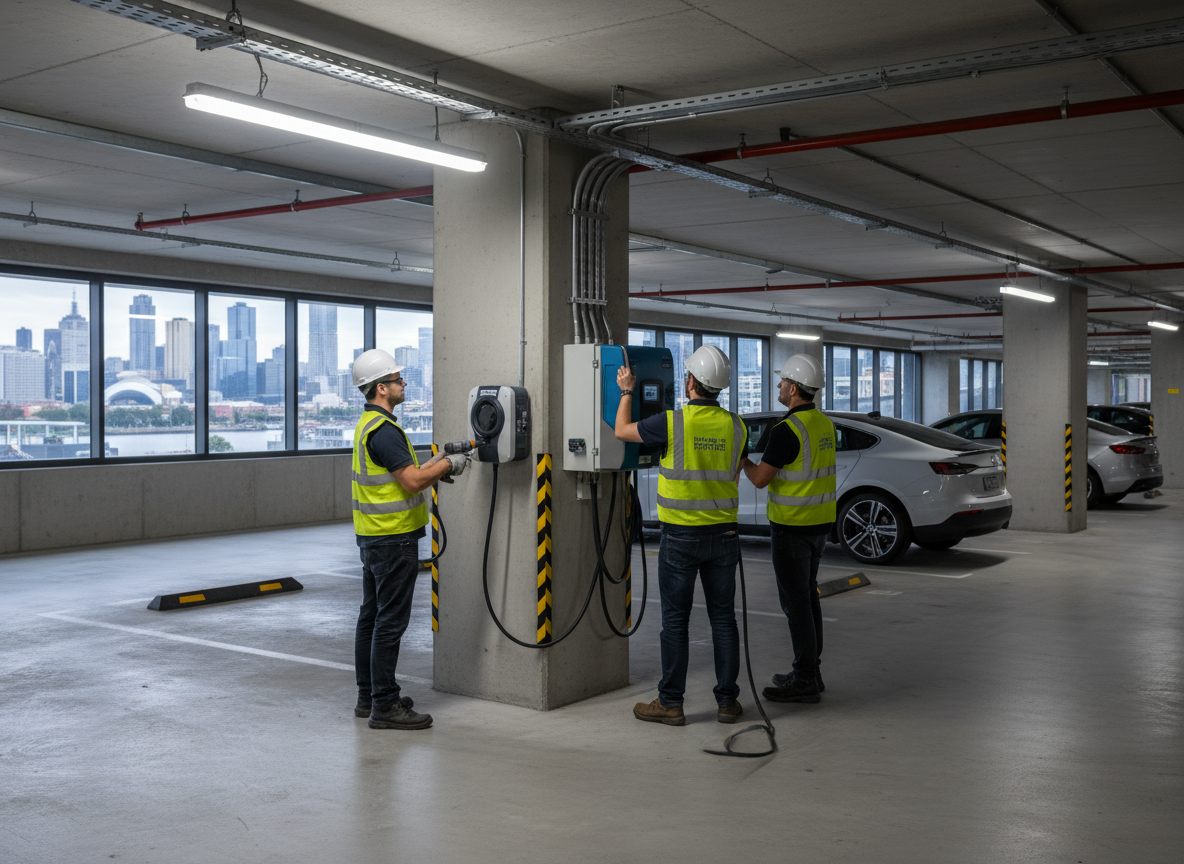
Who three-phase home charging suits
A three-phase charger makes sense in a Melbourne home that already has three-phase supply and a car whose onboard charger accepts more than about 7kW. These units can deliver 11 to 22kW, but the car sets the ceiling, so plenty of drivers charge just as quickly overnight on a single-phase 7kW unit.
Understand the onboard charger limit
A wall charger supplies AC power, and the car converts it to DC inside the vehicle. If that onboard converter is rated at 11kW, a 22kW wall unit still only delivers 11kW. Look up the maximum AC charging rate in the owner's manual or spec sheet before paying for bigger hardware.
How to tell if your home has three-phase power
At the switchboard, a main switch that spans three poles side by side is a common sign of three-phase supply. Your electricity distributor can confirm it for your address, and the electrician will check it on site. If you are unsure, note that and the assessment settles it.
Why faster is not always the better decision
Most cars sit in the driveway for many hours overnight, and a 7kW charger refills a typical daily commute well within that window. Three-phase earns its place when the car accepts 11kW or more, daily distances are long, two EVs share the supply, or the next car you plan to buy charges faster.
Network approval and load management
Larger chargers and any change to your supply can involve the distribution network provider for your street: CitiPower, Powercor, AusNet, United Energy or Jemena. Load management lets the charger reduce its current when the house is drawing heavily, keeping the total within what the supply and switchboard can carry.
Electrical safety paperwork once installed
At handover, the installing electrician must issue a Certificate of Electrical Safety and give you a copy. If the three-phase job counts as prescribed work, an independent Licensed Electrical Inspector has to inspect it first, before it is connected or left energised. Keep the certificate with your home records.
Next step: match the charger to your car
Write down your car model and its maximum AC charging rate, check whether the main switch looks single or three-phase, and note your suburb. Request a quote here once those details are noted, and a licensed and insured local contractor can follow up. Mention any second EV you plan to add, since that can change the sizing.
Three-Phase EV Charger Installation Services We Offer
✓Three-phase Charger on Existing Supply
For homes that already have three-phase power: a dedicated charger circuit and an 11 or 22kW unit matched to the car's onboard limit.
✓Three-phase Power Upgrade
For single-phase homes considering faster charging: supply and switchboard changes that involve the local distribution network provider.
✓Load-managed Three-phase Charging
A charger set to reduce its output when household demand is high, keeping total load within what the supply can handle.
How it works
- 1
Check the car and the supply
Confirm the car's maximum AC charging rate and whether the home has single or three-phase power, so the charger is sized to what the car can actually use.
- 2
Site assessment
The electrician inspects the switchboard, supply and parking spot, then confirms whether a three-phase unit, a 7kW charger or a supply upgrade fits the home.
- 3
Network approval and installation
Any notification or approval from the distribution network provider is sorted, then the charger goes in on its own circuit with load management where needed.
- 4
Testing and certificate
The installation is tested, inspected where the work requires it, and you receive a copy of the Certificate of Electrical Safety.